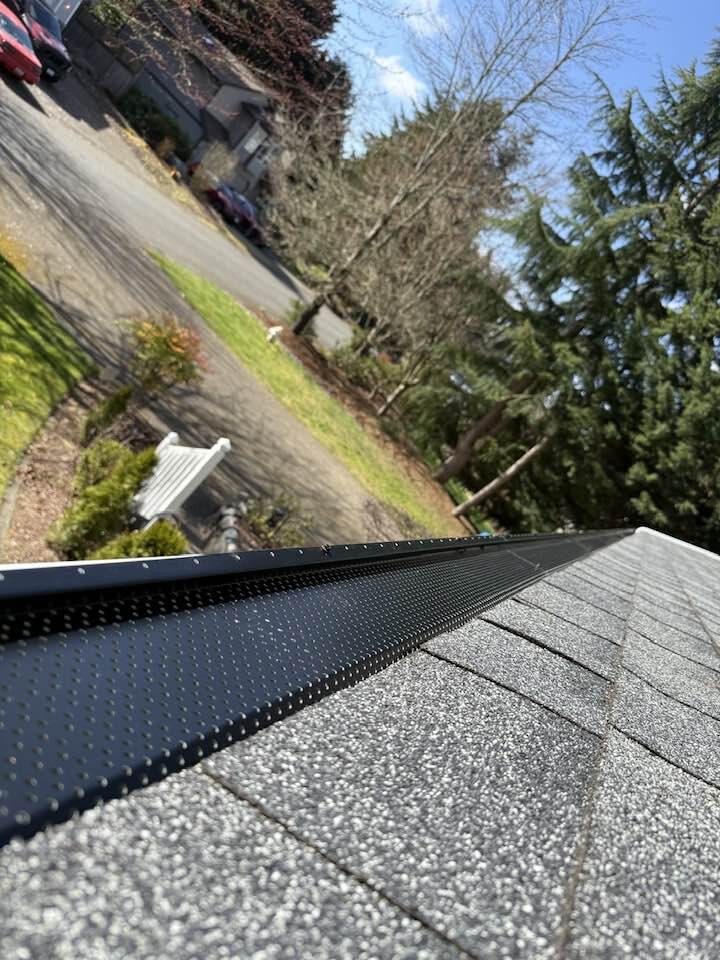
Gutter Guards
Gutter Guards That Actually Work in the Pacific Northwest.
Most gutter guard products are designed for deciduous leaf loads. Pacific Northwest gutter debris doesn't behave like that. We install guard systems evaluated specifically for PNW debris conditions — not one product for every customer.
Why Guard Selection Matters in Western Washington
The Needle Problem
Douglas fir, Western red cedar, and other conifers shed needles year-round, with heavy drop periods in late spring and fall. Needles are typically 1" to 2" in length and thin enough to pass through the mesh openings that stop most leaves. The guard systems that perform best against needle loads use finer mesh openings, surface tension flow paths that float needles off the edge, or a combination of both.
Rainfall Intensity
Western Washington receives rainfall in concentrated events — atmospheric river conditions during winter can produce several inches in 24 hours. A guard system that restricts water entry below the inflow rate of the gutter will overflow. Guard systems need to allow sufficient water flow to handle the actual rain events in this climate, not just average conditions.
Moss Compatibility
Moss spores land on everything in the PNW, including gutter guards. Some guard systems create surfaces that retain moisture and accelerate moss growth, which then blocks the guard itself. Material selection and surface texture affect moss compatibility.
Roof Pitch
High-pitch roofs accelerate water flow to the gutter edge and also shed debris with more force. Guard systems that rely on slow water adhesion to the guard surface work less reliably on steep pitches. We account for pitch in our recommendation.
What Gutter Guards Can Do
- Significantly reduce the frequency of gutter cleaning required
- Prevent large debris from entering the channel
- Reduce the risk of downspout blockage from bulk debris
- Extend the interval between full cleanings in moderate-canopy situations
What Guards Don't Do
- Eliminate the need for cleaning entirely — fine debris, moss, and granules still accumulate over time
- Protect against all debris types equally — needle loads exceed the capability of many standard products
- Compensate for an undersized or poorly pitched gutter system beneath them
We tell customers upfront: gutter guards reduce maintenance, they don't eliminate it. A realistic expectation is moving from two to four cleanings per year to one to two, depending on canopy density and product selection.
Our Process
Canopy and Debris Assessment
Before recommending a product, we evaluate what's actually landing in your gutters — needle load, leaf volume, moss presence, and seasonal patterns based on your specific tree types.
Gutter Condition Review
Guards installed on a gutter system with pitch problems, loose hangers, or section damage will underperform. We assess the underlying gutter condition before installation and address any issues first.
Product Selection
We recommend the system best matched to your debris type, roof pitch, and gutter profile. We explain the tradeoffs clearly.
Installation and Expectation Setting
Guards are installed according to manufacturer specification. We walk through realistic maintenance expectations for the specific product installed before we leave.
Want to know which guard system matches your property? We assess before we recommend.
Get a Free EstimateFrequently Asked Questions
-
For most homeowners with significant tree canopy, yes — with realistic expectations. If you're currently cleaning gutters three or four times a year, a well-matched guard system can reduce that substantially. If you're cleaning once a year on a low-canopy property, the cost-benefit math is closer. We give you an honest assessment based on your specific situation.
-
It depends on the guard system and how it attaches to the gutter. Some systems attach to the fascia and don't affect the gutter itself. Some clip to the gutter lip and can affect the gutter's profile. We use systems compatible with the gutters we install and will advise on compatibility with existing systems.
-
Yes, in most cases. We assess the existing gutter condition first. Poorly pitched or damaged gutters should be corrected before guard installation — otherwise the guard makes the underlying problem harder to detect.
-
Yes. Most quality guard systems are available in both 5" and 6" profiles. We confirm sizing at the estimate.
-
Quality aluminum and stainless mesh guard systems last 15–20+ years with normal maintenance. Plastic and foam insert products have significantly shorter lifespans and we don't install them.
Stop Climbing the Ladder
Stop climbing the ladder three times a year. A-Team Gutters installs guard systems that perform under real Pacific Northwest debris loads.